
Skip to content
Official Blog of the AALS Section on Contracts

Brian Bix, How Do You Explain Contracts Theory to Advanced Beginners?
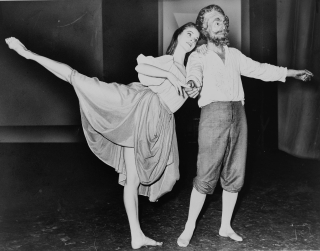

Suzanne FarrellWhen I was young and danced, my first ballet class was for “advanced beginners?”  Why?  Well, I wasn’t a beginner — I taken a lot of dance classes before I took ballet.  I had tights; I had slippers.  All I need is a mask, and maybe Suzanne Farrell (right, with George Balanchine) would allow me the pleasure of a pas de deux. The class had everyone in it — from people like me who had no business being there — to borderline professionals who just took whatever class fit into their schedule so long as they liked the instructor or knew the instructor would leave them alone.   It was a great level, and I stuck with it throughout my years as  . . . well, let’s just say, as someone who took ballet classes.  Ten years in, and still an advanced beginner.  No shame in it.  

Brian BixDespite my experience with advanced beginning, I wasn’t sure what Brian Bix (left) had in mind with his Advanced Introduction to Contract Law and Theory.  It very quickly became clear to me that I would recommend this book to my students at the end of the semester as they are preparing for the exam.  It’s not something you can read before you take a contracts course.  It’s not really the kind of hornbook, larded with hypos and examples from the caselaw that I would assign as a supplement.  But it is a great, quick, efficient and reliable overview that one can use just at the point when you want to bring all of the concepts together in a coherent Gestalt.  

The tone is conversational and direct.  Professor Bix introduces a topic and then recounts the relevant rules.  Then, in separate paragraphs, he explains exceptions to the rule or situations where the rule does not apply even though one might think it would apply.  He assumes some familiarity with contract law — you already have the shoes and the tights; you just need to improve your technique and refresh your recollection so that you can distinguish a pas de cheval from a pas de chat.  Professor Bix makes the  transitions between the doctrinal sections seem obvious, effortless, and natural, but anybody who has ever tried to put together a syllabus knows how easy it is to make a faux pas by introducing a doctrine that relies on another doctrine that you haven’t yet explained.
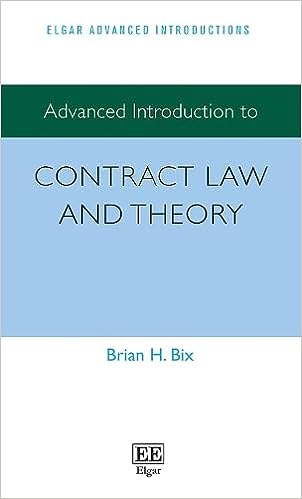
Advance IntroHaving accomplished a brisk and efficient summary of contracts doctrine in eighty pages, Professor Bix then devotes just over twenty pages to contracts theory.  Contracts is a practical subject, and so Professor Bix notes, theoretical approaches to contract law tend to combine explanation, rational reconstruction, and justification.  He then provides a nifty summary of the major approaches to contracts theory.  I usually start my course with an overview of theoretical approaches to contracts law, and throughout the course, I remind students of those approaches as they inform the opinions that we read.  The way Professor Bix organizes this material offers an opportunity to look at it afresh.  

Professor Bix starts with Charles Fried’s theory of contract as promise and critiques of that, which construe contracts as being more about consent or reliance.  Next he reviews theories that think about contracts as creating property rights.  He then moves on to relational contracts, efficiency perspectives on contracts rules, and critical approaches, which focus on modern contracts of adhesion and can transform the view of contract as being about consent into a tool for challenging the legitimacy of form contracting. 

Professor Bix provides useful perspectives on contracts law and theory.  It is a valuable book to have, as  I suggested earlier, for students seeking to firm up their grasp of contracts law.  It is also a good book for them to have on their shelves as they move into practice so that they can quickly brush up on areas of contracts doctrine as they arise.  And for those of us who like to not only practice law but also to understand what ideas underlie it, the book is one to which one can return to remind oneself of the contending theories about what animates contracts law.  And then one can make use of Professor Bix’s footnotes and bibliography to explore matters further.  In contracts, as in ballet, we can all use the occasional master class for advanced beginners.