
Glacier Northwest: Why Did SCOTUS Bother to Issue an Opinion?

The applicable standard is that, in order to avail itself of what is called “Garmon preemption,” the union must undertake reasonable precautions to protect the employer’s property from foreseeable harm. If Garmon preemption applies, the state proceedings are stayed pending a determination by the National Labor Relations Board (NLRB) of whether the union activity is permissible under the National Labor Relations Act (NLRA).
The company alleged that the workers had gone on strike without notice, leaving cement in trucks. Although the company could not claim that any trucks were damaged, it did allege that at least some of the cement dried and became unusable. Accepting the facts as alleged in the employer’s complaint, the majority found that the workers had not taken the necessary reasonable precautions, and thus the company’s state tort claim was not subject to Garmon preemption.
Big whoop. Why decide this case? When the case goes back down, the facts as alleged in the complaint may not be provable. And then what do we have? We have a spot of mischief: a SCOTUS opinion that offers employers the possibility of holding unions responsible for economic harms attendant to a strike, based on mere allegations. Justice Barrett’s majority opinion adopts the complaint’s tone of moral outrage before the veracity of any of the facts of the complaint have been established. So the entire case is a hypo. Sounds a lot like an advisory opinion.
Justice Barrett has advice for the unions about how to take reasonable precautions:
It could have initiated the strike before Glacier’s trucks were full of wet concrete—say, by instructing drivers to refuse to load their trucks in the first place. Once the strike was underway, nine of the Union’s drivers abandoned their fully loaded trucks without telling anyone—which left the trucks on a path to destruction unless Glacier saw them in time to unload the concrete. Yet the Union did not take the simple step of alerting Glacier that these trucks had been returned. Nor, after the trucks were in the yard, did the Union direct its drivers to follow Glacier’s instructions to facilitate a safe transfer of equipment.
In short, the union, which had no legal obligation to provide notice to the company of its strike, is here expected not to take “reasonable precautions” but to take every precaution, including instructing striking workers to follow the employer’s instructions. It’s almost as if none of the Justices who joined in the judgment have ever been in a union.
Justice Kagan, who joined the majority for reasons about which I speculate below, was persuasive on this issue during oral argument.
. . . [W]orkers unions do things all the time intentionally to maximize economic harm. You know that if there is a seasonal component of a business, workers will try to time their strike in order to maximize the economic harm because, you know, more of the business is conducted in the summer than in the winter and things like that, that there are all kinds of things which are perfectly intentional to maximize economic harm. . . .
The majority opinion does significantly less harm than it might have done. It is incredibly narrow and fact-specific. It expressly does not hold that workers can be liable whenever the strike will foreseeably cause harm to perishable goods. It acknowledges that workers are not legally obligated to provide notice of a strike. It acknowledges that workers may sometimes elect to strike during the workday. Most importantly, the majority dodges the administrative law question raised by the case. Because the Court found that the conduct alleged was not subject to Garmon preemption, it did not address whether the National Labor Relations Board or the state courts should decide the tort issue in the first instance.
Justice Thomas, joined by Justice Gorsuch, concurred to signal their hostility to the scope of Garmon preemption, which pauses state tort claims whenever union activities are arguably protected under the NLRA. That, the concurring Justices signal, is too much preemption. Justice Alito, joined by Justices Thomas and Gorsuch concurred to emphasize that the conduct alleged clearly was not protected under Garmon. I thought that’s what the Justice Barrett’s opinion said, but whatever.
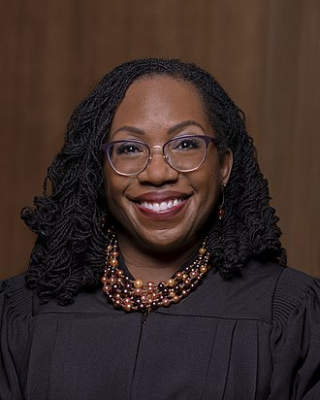
Justice Jackson (right) also points out that what the other opinions all cass “Garmon preemption” is really just a hiatus. State tort claims are suspended until the NLRB makes a determination on the facts. If the NLRB determines Garmon is not implicated, the case proceeds. In this case, Justice Jackson seems confident that if one looks beyond the facts as alleged in the company’s complaint, the allegedly tortious union activities were likely protected strike activities.
In this context, I think it makes sense that Justices Kagan and Sotomayor joined Justice Barrett’s very narrow opinion rather than writing with Justice Jackson. Justice Jackson’s dissent makes clear that Garmon was implicated in this case, because the NLRB action against Glacier means that the union’s challenged activities clearly met the standard of being “arguably protected.” If Justice Kagan and Sotomayor had joined Justice Jackson, the conservative Justices might have felt compelled to address Garmon, and I’m pretty sure they would have killed it in favor of letting state courts rule on tort issues in the first instance. Justices Kagan and Sotomayor may have elected to join Justice Barrett’s opinion because that opinion allowed Garmon to live to fight another day.