
BigLaw and Non-Negotiable Expectations
I worked at a BigLaw firm. It was a great experience. I worked long hours, but I mostly worked for a partner who, like me, was a new father. He had four children — triplets, followed by “baby oops” 14 months later. I had just one daughter, but she was reason enough for me to value weekends in Brooklyn. So we both worked long hours during the week, getting to the office by 9:30 and working until 8 PM or so some nights and until 2 AM others. Once it got past 8 PM, it didn’t much matter to me how late I stayed, as my wife and daughter would be asleep when I got home in any case. The partner I worked for would go home to help his wife with bedtime rituals, but he had a home office, and we would be in touch through the night.
The work was interesting, and I really liked my co-workers. They were serious but fun-loving, with the gallows humor that comes from hard toil in relatively luxurious surroundings and punctuated by occasional experiences of plenty beyond our youthful imaginings (at least for some of us). Senior associates were for the most part supportive and mentoring, partners were demanding, but avuncular (there were precious few women partners in our group), serious, capable, and hard-working. I did not aspire to their stations. They worked as hard as I did, and they had to deal with clients, from whom I was wisely kept away.
And yet, as great as the experience was, every time someone left the firm, we all thought that they were leaving for something better, and we were happy for them. When I took my farewell tour of the firm, senior associates were wistful. I had a Ph.D., so the leap to academia made sense and seemed fore-ordained. I had been teaching as an adjunct at Brown the semester before I left (one can bill a lot of hours in the “quiet car” on the Acela from Manhattan to Providence!). There were sighs and references to golden handcuffs.
Last week, Bethany Biron of the Business Insider along with many other sources, shared this slide, allegedly from a presentation given to new associates at Paul Hastings:
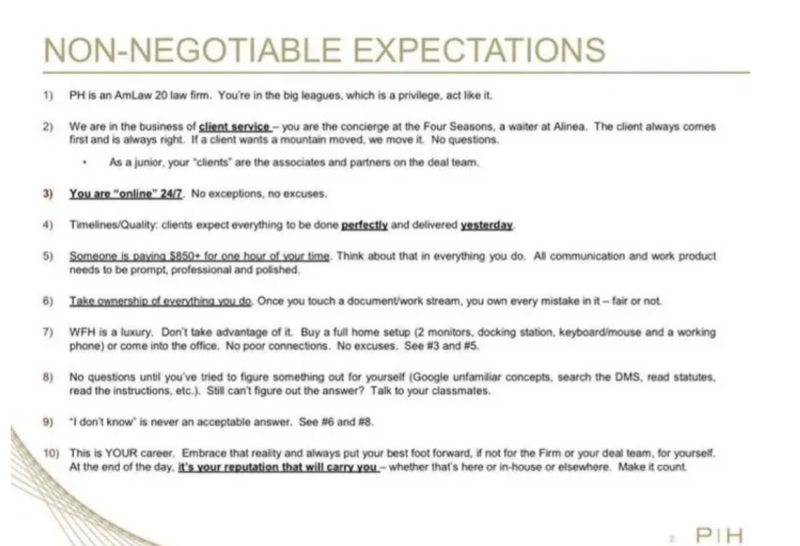
1. My salary as an associate was shockingly high — starting at four times what I made as a history professor before going to law school. Other than that, my job was not a privilege; it was the offer I took among other offers. Most of my peers had far more offers than I did, and the job was, for most of us, a stepping stone or a means of paying off loans and getting good experience before moving into a more comfortable life.
2. My relationship with senior associates and partners was collegial. As a litigation associate who mostly wrote briefs, I was deferential to what more senior lawyers told me about what to include in the brief, but I would also push back if I had become more familiar with the law or the facts because I was closer to where the rubber hit the road. Other than a couple prickly senior associates who were more interested in their status than in being good at their jobs, the people I worked with would not have wanted it to be otherwise.
3. Once in my four years at the firm, a partner chastised me for not seeing a voice mail he had left me at 7 AM until 9 AM. He yelled at me, and I yelled at him, because he could have e-mailed me if he really wanted to contact me — I would have seen that and come in early. I had been in the office until 2 AM the prior night working on a brief. He was mad, but he was also grinning a bit, perhaps remembering why he never wanted to work with me. He didn’t give me any more work after that, and that’s fine. He chewed up associates and spat them out, but he wasn’t going to get his teeth into me.
4. As a litigation associate, my timelines were set by courts, not by clients. We did good work for clients, making troublesome suits go away through dispositive motions. I never felt any pressure from clients to work at anything other than my usual pace. The partners told me when they wanted things, and I met the deadlines.
5. Associates are billed out at ridiculously high rates. That is true. It is also true (or so I was told) that clients challenge billing rates, and partners have to write off time that is not well spent. That is the real point — if you are not productive, you are expensive for the partner; that is what you should probably keep in mind.
6. It is true that a person who gets paid like the associates at BigLaw should own their mistakes — and such mistakes should be exceedingly rare when the stakes are high. But you are always part of a team, and when my team made mistakes, we put all our energy into addressing the mistakes and none of our energy into determining who made the mistakes, unless in an attempt to make sure that the mistakes were not replicated.
7. Work from homes was not a thing in Y2K, and I don’t understand the passion for it now. I loved going to work and seeing my colleagues face to face. I still do.
8. No questions? Life for me was a continual back and forth with the partner and associates with whom I worked. When I rose to the level of mid-level associate, I would have been miffed if I gave an assignment to a new associate and they did not come back to me with questions. They would spin their wheels and waste their time.
9. If “I don’t know” is the truth, it is the best possible answer. Especially if it is followed up with, “I will research the matter and get back to you.” I had the experience many times that a more seasoned lawyer would ask a question to which I had no good answer. They knew to ask about what were for me unknown unknowns. Pretending that I knew about something I had not considered would have been disastrous for all involved.
10. For some new associates, the firm is the beginning of a career; for others, it’s a job. It can be rewarding; you can learn a lot, but it might not be your passion. If you cannot find the inner resources to do your job to the best of your ability, you should indeed move on. But your reputation does not turn on it. Firms do not bad-mouth former employees. I worked with only two really bad lawyers at my firm. One became a head-hunter, and she had a very successful career. The other became a journalist, and he has nearly 100,000 Twitter followers. I worked for another lawyer who wanted ever-so-badly to be a partner. He didn’t make it. They rejected him. He went in-house for one of the firm’s clients, and the last time I saw him he was regaling partners with stories that I doubt were any more interesting than the stories he told as a senior associate. They hung on his every word, stopping only to refill his drink or fetch him more hors d’oeuvres.