
Sid DeLong, A Streetcar Named Deontology
What follows is Sid DeLong‘s inaugural post:
Most of you are familiar with the ethics conundrum known as The Trolley Problem: “Should I throw a switch to divert an unstoppable trolley that would otherwise kill ten people if doing so would cause it to kill one person standing on the siding”?
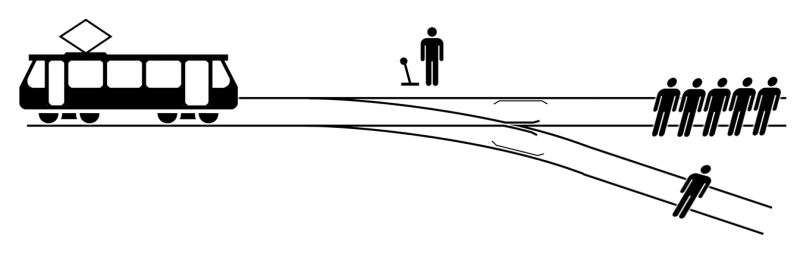
In the comfort of the classroom, most people side with the Utilitarians, who say that switching is justified because, although it causes the death of an innocent person, it saves the lives of ten. But a substantial minority vote with the Kantians, on the grounds that deliberate homicide is never justified regardless of its effects.

Oddly, however, studies show that most people would refuse to save ten people if, instead of diverting a trolley, they were required to throw an innocent bystander into its path. A lot of Utilitarians vote with the Kantians on this one, displaying a selective squeamishness that has inspired generations of research in philosophy and neuroscience.
Efficient breach of contract can raise an even more complicated moral anomaly. Consider The Vaccine Problem. Assume that a monopolist seller of a scarce, life-saving vaccine enters into a contract to sell its last batch of 10,000 units to Buyer1, a private hospital with patients suffering from the deadly disease it cures. Seller is then approached by Buyer2, another private hospital with many more such patients. It becomes apparent that, if the vaccine goes to Buyer 1, ten people at Buyer1 will live and one hundred people at Buyer2 will die. If it goes to Buyer2, one hundred people at Buyer2 will live and ten people at Buyer1 will die.
Scenario 1: While the vaccine is still in Seller’s possession, Buyer2 offers Seller ten times the contract price for the vaccine. Should Seller breach its contract with Buyer1 and sell the vaccine to Buyer2? By “should,” I mean would it be the right thing to do?

In this version of the Trolley Problem, instead of saving lives by tortious means, the Seller saves them by breaching a contract. Pro-efficient-breach Utilitarians would argue that the deaths at Buyer1 are outweighed by the lives saved at Buyer2 under a sort of biological Kaldor-Hicks standard. In a vaccine auction, Buyer2 would outbid Buyer1. Anti-efficient-breach Kantians would argue that deliberate breach of contract is never justified by its consequences. An auction would be bogus because human lives cannot be valued in any currency, even in other human lives.
But the Vaccine Problem forces the Kantians to address a new moral question that they are able to duck in the typical efficient breach case: What are the relative moral claims of Buyer1 and Buyer2? Kantians must not only weigh the sacredness of the Seller’s promise against the value of human life; They must also weigh the value of one hundred human lives against the value of ten. Deontologists abjure weighing of any kind because absolute moral principles are incommensurable, unquantifiable, and never in conflict.
Scenario 2: Seller delivers the vaccine to Buyer1. Buyer2’s agents then steal the shipment from Buyer1. Buyer2 sends Buyer1 a check for ten times the purchase price.
Stealing the shipment after delivery is the analogue of pushing the person into the path of the trolley. Pro-efficient breach Utilitarians have always been haunted by the specter of “efficient theft.” While act utilitarians might vote to steal the vaccine, fair weather rule utilitarians, who hold property rights are efficient, will join the Kantians in condemning the theft even if it costs lives. The best they can do is to insist that Buyer2 engage in a market exchange with Buyer1.
But if the right answer to Scenario 1 is to allocate the vaccine to Buyer2 because that is where it is most needed, then why isn’t that also the right answer to Scenario 2? Is property more sacred than promise even when life hangs in the balance? Conversely, however, if theft is justified in Scenario 2, “Where will it all end?”
(Thanks to Greg Klass, who identified an earlier version of this hypothetical as a version of the Trolley Problem on the Contracts Listserve.)