
Clever Price Interpretation Issue
Take a look at the below quote for “calendered” fabric by weight and consider what you think is the total price for the fabric (“tire cords”) including the calendering process by which rubber is compressed into the fabric sheets. There is no dispute that the “Polyester Tire Cord Only” line refers to fabric sheets purchased by Obermeyer from CSI and that the “Calendering, Compound & Poly Only” line refers to the calendering. Consider also that to get one pound of calendered fabric, Obermeyer would buy one half pound of fabric sheet at $1.87 and pay $2.23 to have that amount calendered into one pound of fabric.
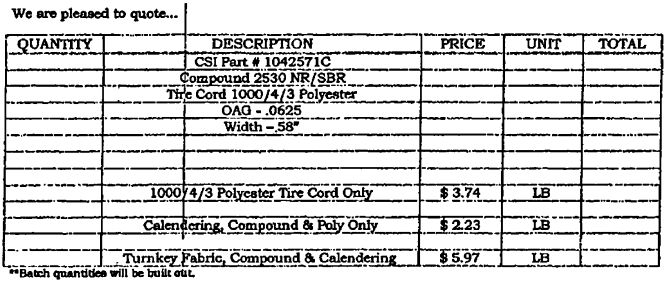
Should the total price be $4.10 or $5.97? Buyer says $4.10. Seller, of course, insists on $5.97; an almost 50% price increase above the buyer’s expectations. How would that be possible? Consider this:
“The increase is a consequence of the fact that calendering doubles the weight of the fabric. To obtain one pound of calendered fabric under the [above] pricing, Obermeyer would purchase one-half pound of fabric sheet (for $1.87) and pay $2.23 for that half pound to be calendered into one pound of calendered fabric. That came to $4.10 per pound of calendered fabric. Under CSI’s interpretation of the January quote, however, Obermeyer would pay $5.97 for the same product. The essence of the parties’ dispute is whether the $3.74/lb price of the fabric sheets is based on the weight of the untreated sheets (the untreated pricing) or the weight of the calendered product (the treated pricing).”
A motion for summary judgment was granted in favor of CSI. A Tenth Circuit Court of Appeals Court reversed and remanded for further proceedings to, among other things, allow the lower court to find out what the course of dealing between these parties had been. Said the court:
“CSI cautions that a decision against it would inject untenable uncertainty into commercial transactions by encouraging contracting parties to remain ignorant of the prices they pay. We disagree. There is a strong policy interest in encouraging trust between parties to commercial transactions. Commerce is not enhanced if buyers and sellers must always treat each other as adversaries, auditing every transaction as it occurs to be sure the other party is not cheating. If the jury finds that Obermeyer had been misled by an unscrupulous supplier on which it had relied in good faith, we do not think that the world of commerce will suffer from a verdict in favor of Obermeyer.
The case shows the importance of sufficiently elaborate contract drafting. Sometimes, less is more, but at other times, such as here, more detail would have been helpful. After the fact, it is much more difficult to ascertain whether fraud was at issue from the outset, at the end, or whether the buyer simply misunderstood the situation… the latter is a little hard to accept on the given facts, but on remand, hopefully the truth will come out.
The case is Obermeyer Hydro Accessories, Inc. v. CSI Calendering, Inc., 2017 WL 1174350, No. 16-1083 (March 30, 2017).