Contracts in the Corporate Setting
Friday afternoon at KCON XII included an excellent panel on corporate contract law issues, including the new Benefit Corporation business entity form and exploring the problem of data privacy. The notes are rough and may contain scribal errors, but they hopefully provide you the flavor of the proceedings.
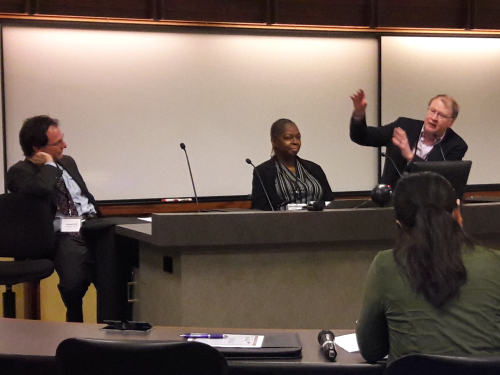
From left: Michael Dorff, Pamela Edwards, and Mark Gergen (not pictured–Summer Kim (Moderator))
Michael Dorff (Southwestern): “Benefit Corporations–Assessing the Assessment: B Lab’s Effort to Measure Companies’ Benevolence.” Only about 3,000 Benefit Corporations (“B Corps”) exist in 31 states as a relatively new form of business entity. B Corps are required to consider community interests and social benefits rather than principally profits. What does this different structure add? Officers include Benefit Directors and Benefit Officers and allow a special kind of derivative suit. Ultimately the force toward social benefits seems to be toothless. The B Corp only works if you believe in it. What makes this system work is the B Lab Certification Process. Thus, the certification contract matters more than the state statute. B Lab has the BIA, “the B Impact Assessment.” Assessment tools need simplicity, reliability, validity, transparency, credibility, and efficiency. It must measure what people care about or no one will pay attention to the assessment. Professor’s Dorff’s paper assesses the viability and value of the B Lab assessment. Companies must want to engage in this process and it has to be doable. The BIA is heavily customized for company size, industry sector, etc. and to date 72 versions of the BIA exist. Companies must score 80 out of 200 to be certified. The BIA is ultimately simple, but comparing across categories is difficult. Questionnaire is long and complicated, which makes it hard for companies. Fault is that BIA measures virtue (good intentions) rather than actual impact. Negative behavior does not deduct from the score. Points are not readily translatable–how does helping the homeless compare against preventing pollution. BIA is a good first cut at the problem, but more needs to be done.
Pamela Edwards (CUNY): “Have Public Benefit Corporations Benefitted the Public?” B Corps are valuable as an attempt to account for constituencies other than shareholders and their profit. This has been a problem since 1919 in corporate law. Moving away from that premise is valuable in changing what the premise is of a corporation. Notably, regular corporations seek to promote their actions as beneficial. Are B Corps actually helping anyone? Too early to tell–but it may be too optimistic to expect corporations to be agents of change due to the B Corp entity form. Agrees with Professor Dorff that comparisons of different companies are difficult to make. The greater ability to challenge a corporation’s decisions beyond the standard business judgment rule is a significant feature. Notably, that was one of the purposes of B Lab’s founders who had seen his corporate vision and culture destroyed after selling his business. Business entities are able to move in and out of being in the formal B Corp form. While that flexibility can be useful, it lessens the ultimate impact of the business form.
Mark Gergen (UC-Berkeley): “Privacy, Privity, and Collective Private Ordering.” U.S. privacy law is in limited silos–FTC, HIPPA, etc., unlike the more comprehensive approach in Europe and elsewhere. Can breach of contract litigation fill the gap? Probably not–courts have been very hostile to privacy claims, frequently by misstating or ignoring established contract law, such as claims for disgorgement and restitution. Just because compensatory damages are not available does not mean that breach of contract claims are note available, yet that is where the privacy decisions are heading. Google and Facebook actually aren’t the problems here, not because of damages but because of market forces. The real problem is THIRD PARTIES–data brokers, against whom you can’t bring a breach of contract action because you have no privity of contract. Europe and HIPPA (as a U.S. example) require that a contract exist containing consent. That won’t work with gateway data harvesters. The real way to solve this problem is to recognize a property right in personal privacy–but that’s unlikely in the current political climate. Another possible solution: data firms must give a warranty that your data won’t be acquired. If a 3rd party acquires the data, then it is liable for tortious interference with contract. The Yelp (review for hire vs. restaurant) case illustrates the viability of a tortious interference claim. Only way to get out of liability would be for the gateway firms to get a standard license. Here, private ordering doesn’t require the creation of a property right. Ultimately, the tortious interference route may be our best hope for protecting personal data privacy.