
Revisiting the Contracts Scholarship of Stewart Macaulay, Post III: Kate O’Neill
This is the third in a series of posts in our online symposium on the Contracts Scholarship of Stewart Macaulay. More about the online symposium can be found here. More information about this week’s guest bloggers can be found here.
Kate O’Neill‘s is Professor of Law at the University of Washington School of Law. Her principal interests are contracts, copyright, legal rhetoric, and law school teaching.
These essays present enlightening, provocative, andwell-written analyses of relational contract theory, contract doctrine, legalpractice, and social justice. Theeditors have sequenced and grouped them skillfully so that the reader canclearly see how the authors’ ideas intersect and diverge. As a result, the collection is more than itsparts.
I want to draw readers’ attention to a problem thecollection suggests but doesn’t address directly. What are we going to do about the contractscourse in law school?
Several essays suggest, and Robert Scott’s expressly arguesfor, an emerging consensus that Macaulay’s original insights remain valid andare foundational for both law & economics and law & society theoristsand that these warring camps may have more in common than either has yetrecognized. If Scott and Macaulay areright, then I would wager that most contract courses not only fail to reflectthe consensus but camouflage its most promising lessons.
The consensus seems to include two major points ofagreement. First, unmessy doctrine canbe handy (“Messy,” of course, was Macaulay’s description of much contractdoctrine). Some “sophisticated” contracting parties should be able to makebinding commitments on precisely the terms that they negotiate and, in case ofdispute, they should be able to limit a judge’s interpretative discretion toalter their allocations of risk. Inparticular, they should be able to preclude the judge from resorting to“context” to alter the (presumably) plain meaning of the terms.
Second, consumers and employees should not necessarily bebound by all of the commitments purportedly imposed upon them by adhesiondocuments. Here, we can see fruit borne from Macaulay’s distinction between thereal deal and the paper deal. Terms that are reasonable, typical, or expectedare part of the deal; terms that are not are not. The expected nature of therelationship dictates the real contract terms; the paper contract terms do notnecessarily govern the relationship. We are freed from the mutually exclusiveand entirely fictional alternatives that either a contract was formed on thepaper terms or it was not formed at all.
On the other hand, the collection makes clear that afundamental policy issue remains contested especially in the consumer context –how much contract law should intervene in the market. The familiar alternatives are reflected: 1) let the market discipline bad actors evenif there are a few casualties before the market works its magic because thereis no agency more capable than the market in determining best (read,efficient?) practices; 2) let judges intervene to strike down bad terms –especially those that limit access to courts and class actions – because doingso will hasten market discipline of bad actors and will also relieve hardshipin at least a few cases; or 3) regulatecertain kinds of terms out of existence.
All the authors think that empirical data could help resolvethe policy dispute. Edward Rubin, in particular, suggests that we think ofcontract law as a management tool. If wewere to focus on whether the tool works well to achieve whatever objectives weset, then the legal system could essentially be taught to treat empiricalevidence as intrinsic to the development of law. This is encouraging stuff. A systemicdevotion to empiricism within the legal system might enable us, and the bodypolitic, to clarify debates about what laws are fair and efficacious.
So far, so good, but here is the question that keepstroubling me. If we all are relationistsand empiricists now, and we could use data to make contracting law and practiceboth fairer and more efficient (or whatever other goals we might conceivablyagree upon), what and how we should teach law students?
Macaulay 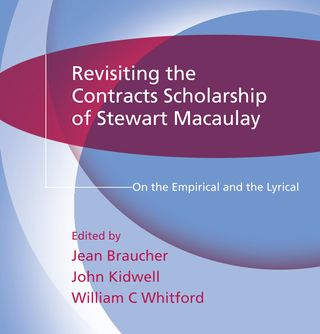
We praise these and other insights from empiricism both forwhat they tell us about law and society now and what they might teach us aboutalternatives. Yet most lawyers and judges plod on, oblivious or dismissive. Arewe in part responsible? Look at our casebooks, listen to our classroomdiscussions! Traditional doctrinalanalysis is alive, well, and I suspect dominant. Economic analysis “lite” hascrept in, but attention to empirical methods, much less data on context orconsequences, is scant. I suspect that even those of us who assign “law &society” contracts casebooks, like the ones edited by Macaulay and DeborahPost, still devote the bulk of class time to doctrinal analysis.
Perhaps this must be. Perhaps doctrinal analysis is our discipline’s unique identifier andmust be taught first because it is foundational; perhaps we need to trainlitigators to understand the elements of a claim for breach; perhaps there issome utility in using the same basic case method in all 1L courses; or perhapswe are simply boxed in by student expectations, bar examiners, tradition, orconfusion about what else to do?
Although there certainly are barriers to changing what andhow we teach, I wonder if the core problem is that the work that needs to bedone is profoundly interdisciplinary, challenging, and time-consuming. Many of us lack the skills to do it alone,and the scholarship, promotion standards, and instructional traditions at manylaw schools still make collaborations difficult.
Contracts teachers may alert law students to Macaulay’sinsights, but I don’t think we give students sufficient tools to help clientsand or work effectively on big systemic problems. Stewart might say that’s because we kindalike the mess the way it is.
[Posted, on Kate O’Neill’s behalf, by JT]