
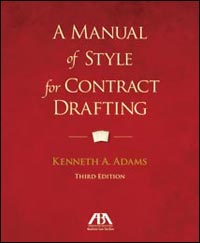
Dean Irma S. Russell, A Review of A Manual of Style for Contract Drafting

Kenneth Adams’ recently released third edition of A Manualof Style for Contract Drafting, is a hefty volume. When I opened the packagecontaining this manual my first thought was: “Wow, this is bigger thanexpected. It looks really time consuming.” At 455 pages, the bookis closer to Fowler’s than Strunk & White. It is worth the time to readit. In fact, once you start reading, itis hard to put down. The writing isclear and concise, the tone is engaging, and the range of usage addressed isimpressive.
This book provides far more than drafting tips. This authorhas considered language in a deep way and gives thoughtful and sometimesprovocative assessments of the usages he endorses. His discussion of thelanguage of belief, the language of intention, the language of recommendationand the distinctions among the categories is notable for its logic and evenphilosophical assessment as well as for its authority of declaring a particularusage superior to other constructions. (Be sure to look for his treatment of “between” and”among” in reference to multiple parties. This discussion may also apply to my lastsentence before this parenthetical.)
The manual is useful for all lawyers who draft agreements, and most do ofcourse. Indeed few lawyers can separate themselves from contract draftingor the need for precise language. A plea arrangement in the criminalcontext is as subject to the risk of ambiguity as a lease agreement. Atort settlement is in as great a need of careful word choice as a corporatemerger. The trap for the casual draftercan involve malpractice claims as well as disappointed expectations ofclients.
The goals the author sets for this work are indeed as worthwhile (and as hardto achieve) in today’s world as in Fowler’s. Creating documents with fewopportunities for confusion means that the careful drafter will not need to seehis words in court and the client will not need to roll the dice of litigationin arguing for his belief or assumptions about the intentions of the parties.
The book delivers on its promise to serve to help its user find “greaterclarity and consistency in written usages.” Though modest in itssuccinct statement, this is an ambitious promise, and one that the bookfulfills. The principle of Occam’s razoris at work here despite the heft of the volume. Each discussion of aphrase or word is brief and to the point. The length of the book results from the number and scope of the issuesaddressed rather than from any drawn out discussions. More elegant contract language is the resultof the guidance offered here. While Strunk & White is certainly shorter, itdoes not take on the range of issues Adams reaches, and I am convinced bothrevered authors would approve of this manual of style.
Opening this book was a Pandora-type move for me, and now I am hooked onthe author’s blog: Adams on Drafting. You can access it here but I warn younow: You can’t read just one. The risk forthe reader opening either the book or the blog is getting caught up in thefascinating world of contract drafting. Even after you find the answer tothe specific question that sent you to the book, you may be unable to stop reading. I’m heading back to the blog now to look formore on “between” and “among.”
[Posted, on Irma Russell’s behalf, by JT]