
Boilerplate Symposium VII: Oren Bar-Gill on Consent Without Reading

Oren Bar-Gill is a Professor of Law and Co-Director of the Center for Law, Economics and Organization, New York University School of Law
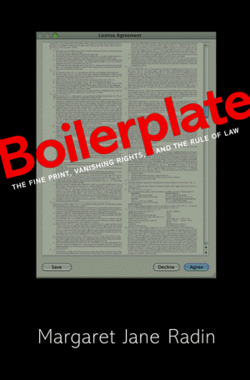
Professor Radin’s book is an eloquent and powerfulcritique of the fine-term, boilerplate contracts that pervade modern life. Itsbreadth – in terms of the range of theoretical perspectives that it considersand the different legal policy responses that it discusses – is impressive. Inthis comment, I focus on the economic analysis of boilerplate. I suggest thatRadin’s treatment of this particular perspective, while clearly very useful,is, in some respects, incomplete.
In her discussion of the economic analysis of boilerplate,Radin focuses on, and criticizes, a Chicago-school approach that minimizes anyconcern about boilerplate. But this is only one strand in the economic analysisof form contracts. There is another, perhaps more influential strand thatreadily acknowledges the challenges that boilerplate presents for marketefficiency and for welfare maximization.
But perhaps there could be meaningful consent withoutreading. Perhaps consumers can learn about the important features ofboilerplate through other means. This is where economists have been focusingtheir recent efforts. Reputation, as bolstered by ratings and reviews (that arebecoming increasingly important with the expansion of the Internet and the riseof social networks), plays a key role here. We see more and more examples wheresellers compete over fine-print terms – where the terms rise from the fineprint to the billboards. Consider automobile warranties or, more recently,early-termination fees in cellphone contracts and late fees and currencyconversion fees in credit card contracts.
Consent, even meaningful consent, without reading ispossible. We cannot always count on it, however. The challenge is to identifythose cases where consent, including consent without reading, is absent. Thatis where we should focus our regulatory efforts.
Along these lines, I note two aspects of consumercontracts that deserve, perhaps, more attention than Radin gives them. First isthe increasingly prevalent problem of unilateral modification, by sellers, ofconsumer contracts (with or without a specific unilateral modification clausein the initial contract). When a pro-consumer contract or term can so easily bechanged, the forces that can generate consent-without-reading are substantiallyweakened.
Second, Radin focuses, in large part, on legal terms. Butnon-legal terms, specifically prices and fees can be similarly hidden andmisunderstood by consumers. Such terms can be as harmful to consumers as theright-divesting terms that attract most of Radin’s critical attention.
Radin’s book is a great achievement. Among its manycontributions is a critical account of the economic analysis of boilerplate.While I agree with much of this criticism, I have tried, in this brief comment,to sketch a richer picture of the economic approach to consumer contracts. Isuspect that Radin would be quite sympathetic to this more nuanced approach.
[Posted, on Oren Bar-Gill’s behalf, by JT]