
Boilerplate Symposium VI: Brian Bix on Democratic Degradation
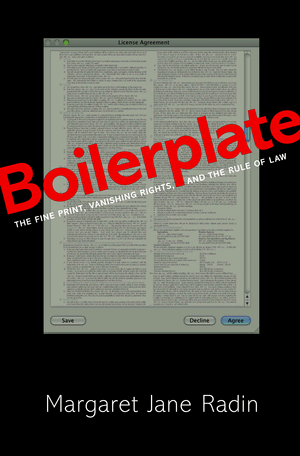
This is the sixth in a series of posts reviewing Margaret Jane Radin’s Boilerplate: The Fine Print, Vanishing Rights and the Rule of Law.

(Thefollowing is adapted from a much longer review that will appear in the Tulsa Law Review.)
In her important, timely, andprovocative book, Boilerplate: The Fine Print,Vanishing Rights, and the Rule of Law, Margaret Jane Radin offers somescathing observations regarding the motivation and effects of the terms placedin consumer and employee contracts. Sheargues that the current contracting practices make a mockery of consent, andundermine the rule of law. Radin isclearly correct in her essential claim, that for many contracting partiesfreedom of contract is less an ideal than a sham, and that boilerplate provisions are being used bycompanies to circumvent substantive rights and remedies consumers, employees,and other contracting parties would otherwise have.
Thereis one issue, however, on which I might want to offer a qualified dissent, orat least suggest a slight modification. In Boilerplate, Radin expressesconcerns about the “democratic degradation,” by which she means the way inwhich important legislatively created rights can be (enforceably) diminished orwaived through contractual agreement. (pp. 33-51) Her argument is thatbusinesses should not be able to undo through simple contractual provisions(especially provisions that are hidden, hard to understand, and hard to avoid)what has been passed through the popular, democratic law-making process.
Similarly, Congressand state legislatures certainly have the ability to make the right to litigatecertain claims or to bring class actions non-waivable, and have occasionallydone so. For example, Congress hasforbidden mandatory arbitration provisions in consumer credit agreements withmembers of the United States military. (See John Warner National DefenseAuthorization Act of 2007, Pub. L. No. 109-364, § 670(a), 120 Stat. 2083,codified at 10 U.S.C. §§ 987(e)(3), (f)(4).) One can also find state laws that expressly restrict the ability ofparties to waive procedural rights, at least for certain categories oftransactions. One example is theIllinois Franchise Act, where Section 4 states: “Any provision in a franchise agreement that designates jurisdiction orvenue in a forum outside of this State is void, provided that a franchise agreementmay provide for arbitration in a forum outside of this State.” 815 ILCS 705/4.
Someone might objectthat the argument here is putting too much argumentative weight on the factthat federal or state legislatures have not acted to restrict the effect ofcontractual boilerplate, and that one should not make too much of legislativeinaction. However, the fact that stateand federal legislatures have shown the ability and willingness to restrict theuse of certain kinds of boilerplate means that the failure to do so in othercircumstances is at least noteworthy. Additionally,Congress has sometimes offered express permission to have certain types ofclaims resolved by arbitration or other forms of alternative disputeresolution. For example, the CivilRights Act of 1991 includes the following language: “Where appropriate and tothe extent authorized by law, the use of alternative means of disputeresolution, including . . . arbitration, is encouraged to resolve disputesarising under [Title VII].” Pub. L. No.102-166, § 118, 105 Stat. at 1081.)
It is not democraticdegradation, but the lesser side of American political life – the power ofbusiness interests, business lobbying, corporate money after Citizens United, etc. – that contributessignificantly to the current contract law world in which rights disappearthrough boilerplate. One need only watchthe way that the Congress continues to hobble the Federal Consumer FinanceAgency (there had once been talk of that agency acting against mandatoryarbitration in consumer and employment agreements, but that now seems highlyunlikely).
[Posted, on Brian Bix’s behafl, by JT]