
The Man Behind Mills v. Wyman
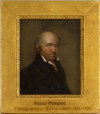 Not many contract cases are more famous than Mills v. Wyman, 20 Mass. (3 Pick.) 207 (1825) in which the Massachusetts Supreme Judicial Court held that a father’s promise to pay a stranger for the care of his dying son was unenforceable for lack of consideration. The author of the opinion was Chief Justice Isaac Parker (1768-1830) (left).
Parker was born in Boston, graduated from Harvard in 1786, studied for the bar, and started practicing in Castine, Maine (then still part of Massachusetts), and later moved to Portland. He served as a U.S. Congressman in the Fifth Congress (1797-99), and then was U.S. Marshal. In 1806 he was appointed Associate Justice of the Supreme Judicial Court, and became Chief Justice in 1814. He remained on the court until his death in 1830. From 1815-30 he taught law at Harvard, and was also an overseer of that institution for 20 years. He was a trustee of Bowdoin College for eleven years. In 1820 was President of the State Constitutional Convention. Yet history largely remembers him for this one short opinion in an insignificant case. Generations of law students have read his opinion of defendant Seth Wyman and his explanation of the rule of law:
General rules of law established for the security of honest and fair-minded men, who may inconsiderately make promises without any equivalent, will sometimes screen men of a different character from engagements which they are bound in foro consicentiae to perform.
. . . On [the son’s] return from a foreign country he fell sick among strangers, and the plaintiff acted the part of the good Samaritan, giving him shelter and comfort until he died. The defendant, his father, influenced by transient feelings of gratitude, promised in writing to pay the plaintiff for the expenses he had incurred. But he has determined to break that promise, and is willing to have his case appear on record as a strong example of particular injustice sometimes necessarily resulting from the operation of general rules.
. . .
A deliberate promise in writing, made freely and without any mistake, one which may lead the party to whom it is made into contracts and expenses, cannot be broken without a violation of moral duty. But if there was nothing paid or promised for it the law, perhaps wisely, leaves the execution of it to the conscience of him who makes it.
The photo at left is of an original pastel portrait of Parker, probably by Felix Sharples, that I bought at an auction in New Orleans last month. Feel free to use the image for any educational or nonprofit purpose.
[Frank Snyder]